# Regex (Regular Expression)

## 1. What's it?

From the 2.3.0 version, Proxyman supports **Wildcard** and **Regex** (Match a whole word) when you define matching rules for all available tools:

* Map Local
* Map Remote
* Block & Allow List
* Breakpoints
* Protocol Buffers (Protobuf)
* Reverse Proxy
* Network Throttling
* ...

It's a handy tool to help you exactly define which requests should trigger the tool.

![Match a request by Wildcard or Regex](/files/-MC_DZnVSPfddI4tnDir)

## 2. Test your URL (New feature 🎉)

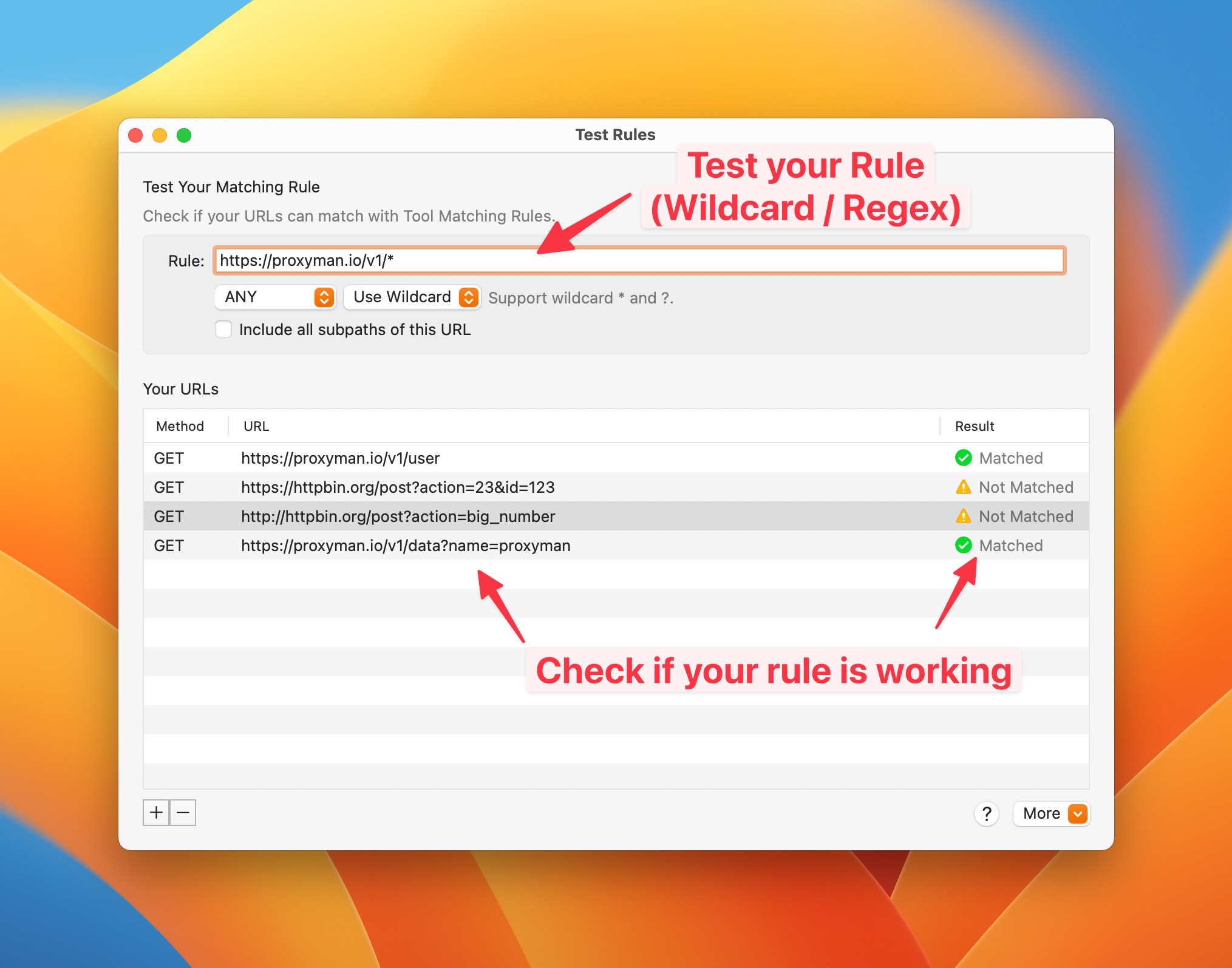
From Proxyman v4.8.0, you can quickly test your Rule (Wildcard / Regex).

* You can quickly test & play around with your Wildcard/Regex
* **Save time**: You don't need to go back and forth to check your URL.
* Less error-prone.

<figure><img src="/files/CGWA8zCN4O1duStCsyYa" alt=""><figcaption></figcaption></figure>

#### How to use it?

1. Open any debugging tools (Breakpoint, Map Local, ...) -> Create a new rule
2. Click on the "Test your Rule" underline button -> New Window is opened.
3. Add your Rule and URLs you'd like to check

* :white\_check\_mark: Matched: Your URL is matched with your rule.
* :warning: Not Matched: Your URL doesn't match your rule. You might rewrite your wildcard/Regex rule.

## 3. Wildcard

Proxyman supports simple Wildcard characters, which include `*` and `?`

| Wildcard | Purpose                                                              |
| -------- | -------------------------------------------------------------------- |
| `*`      | The asterisk in a wildcard matches any character zero or more times. |
| `?`      | A question mark matches a single character once.                     |

For instance:

* <http://proxyman.io/v1/\\>\*
* <https://myserver.com/v?/\\>\*

## 4. Regex

Proxyman also supports Regex.

* Make sure your regex is **matching a whole URL**.
* **Partial Matching** is considered as not matching.
* Make sure you **escape characters** properly: Splash (/), full-stop (.), etc.

For instance:

| Regex                                                                        | Matched URL Examples                                                                                                                              |
| ---------------------------------------------------------------------------- | ------------------------------------------------------------------------------------------------------------------------------------------------- |
| https:\\/\\/proxyman\\.io.\*                                                 | <p><https://proxyman.io><br><https://proxyman.io/v1/data?id=123><br><https://proxyman.io/pricing></p>                                             |
| ^(http\|https):\\/\\/www\\.google\\.com.\*                                   | <p><http://www.google.com><br><http://www.google.com/user?id=proxyman><br><https://www.google.com></p>                                            |
| ^(http\|https)?:\\/\\/www\\.google\\.com\\/v\[0-9]?\\/build\\?query=proxyman | <p><http://www.google.com/v1/build?query=proxyman><br>[www.google.com/v2/build?query=proxyman](http://www.google.com/v2/build?query=proxyman)</p> |

You can use <https://regex101.com/> to verify your Regex that matches the whole text.

![Make sure your Regex matches whole words](/files/3FqmpoejI6t5oWY3jGDA)

{% hint style="info" %}
Please check the [**Regex** **Metacharacters, Operator and Flag**](https://developer.apple.com/documentation/foundation/nsregularexpression#1965590) from Apple Developer Documents to know which one is supported.
{% endhint %}

{% hint style="info" %}
Check <https://regex101.com> and make sure your Regex is full-matching with the given URL
{% endhint %}

* Select Regex when creating rules

![](/files/-MC_GHgRHPy8AUEjilO4)

{% hint style="info" %}
With regular expressions the meaning of `?` and `*` is different from that of wildcards. The equivalent of wildcard `?` is the regex `.` and the equivalent of wildcard `*` is the regex `.*`
{% endhint %}

---

# Agent Instructions: Querying This Documentation

If you need additional information that is not directly available in this page, you can query the documentation dynamically by asking a question.

Perform an HTTP GET request on the current page URL with the `ask` query parameter:

```
GET https://docs.proxyman.com/basic-features/regex.md?ask=<question>
```

The question should be specific, self-contained, and written in natural language.
The response will contain a direct answer to the question and relevant excerpts and sources from the documentation.

Use this mechanism when the answer is not explicitly present in the current page, you need clarification or additional context, or you want to retrieve related documentation sections.
